
Research

Illustration accompanying Yi Wang’s research interests in cosmology and high-energy physics

I work on theoretical high energy physics and cosmology — the connection between the tiniest elementary particles and the entire universe. My main research interest is cosmic inflation, a theoretical description of the very early universe. A focus of my research involves extracting information about fundamental particle physics from the properties of inflation.

I also work on black hole physics (especially black hole superradiance),gravitational waves, cosmic strings, eternal inflation, dark matter, dark energy, modified gravity, AdS/CFT and computer algebra.

A list of my papers can be found at INSPIRE, or HKUST library. See also the research group of Center for Fundamental Physics for related research at HKUST.

(Chinese version here, below is the English version)

Presentation is a piece of art. Thus there is no standard answer for its skills. Nevertheless, there are some suggestions on rules and tricks. They are personal and probably biased. If you are experienced, all are probably breakable.


(Chinese version here, below is the English version)

Congratulations! You are at the point to summarize your scientific findings and put them into a research paper. You might have thought that this is simple. As a student, you have written many study reports – lab reports, reading reports, essay for courses, … However, a research paper is more important, serious, tricky in many ways that you may not have thought of.


(Chinese version here, below is the English version)

Students start to do research by learning the background knowledge and then asking supervisors for projects. After those steps are well done, the students should try to be more creative, generate ideas and find research project themselves. This is a hard but crucial step on the trajectory toward an independent researcher.

I am definitely not creative enough to talk about creativity. Nevertheless, share my two cents with the students who have just started to do research.


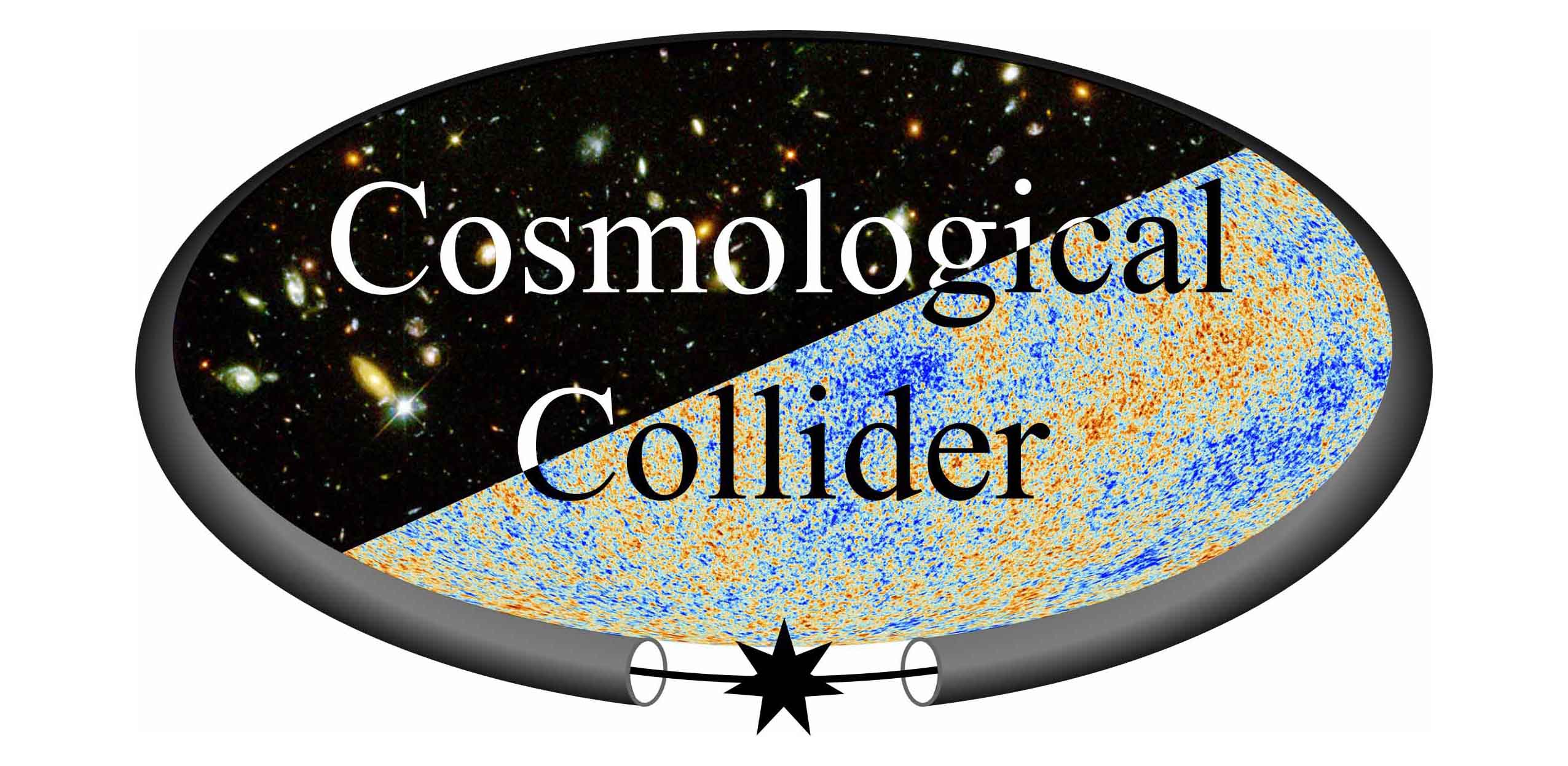
Illustration accompanying the introduction to cosmological collider physics

Signals from the universe played significant role for the development of particle physics. For example, the elementary particle “muon” was discovered in 1936 from cosmic rays. Afterwards, rapid progress of ground based collider experiments quickly took the leading role of studying particle physics since then. However, roughly speaking, the energy scale of new physics is distributed in logarithm scales, but the cost of building ground based colliders scales as a powerlaw with energy. As a result, we cannot rely on the ground based colliders forever for major particle physics discoveries.

Can cosmology return and help particle physics out of this situation?


A 5-min talk of this content is available here.

The expansion of the Universe is the cornerstone of modern cosmology. The evolution history of the Universe has been well measured from the first 3 minutes to 14 billion years.

However, what is the evolution history of the primordial universe, towards a tiny fraction of a second after the Universe was born? The Universe is likely to be exponentially expanding. But alternative theories show that the Universe may be contracting or nearly static.

How to distinguish those scenarios in a model-independent way?

Illustration accompanying the discussion of primordial standard clocks

Cosmology is a special type of science. In typical scientific research, one prepares an initial condition and measure the final outcome after an experiment. However, in cosmology, we do not have control of the initial conditions – they are prepared by Nature.

Especially, the structures in our Universe originates from the quantum fluctuations during the cosmic inflation. It is usually argued that “Bunch-Davies” states are the natural initial conditions of those quantum fluctuations. However, no precise statement has been proposed on how fast the inflationary fluctuations approach to Bunch-Davies after inflation starts, or after the inflationary process is disturbed by features in the potential. Also, the Bunch-Davies approach is not precise enough for nonlinear fluctuations.

How to determine the physical initial condition of inflationary fluctuations?


This is a random collection of tools for doing research. Not organized. Navigate with the table of content for what you need.