AI generated summary: This 2016 article describes how oscillating massive fields can act as primordial standard clocks. Their phases can imprint patterns in primordial correlations, offering a way to investigate the evolution of the very early Universe and compare different expansion histories. The observability of these signals depends on their model-dependent amplitude and on measurement precision.
本文写于 2016 年,介绍大质量场的振荡为何可以充当原初标准钟,以及相位信息如何进入原初关联函数。这些信号有助于研究极早期宇宙的演化并比较不同膨胀历史;能否观测到信号还取决于具体模型中的振幅与测量精度。
A 5-min talk of this content is available here.
The expansion of the Universe is the cornerstone of modern cosmology. The evolution history of the Universe has been well measured from the first 3 minutes to 14 billion years.
However, what is the evolution history of the primordial universe, towards a tiny fraction of a second after the Universe was born? The Universe is likely to be exponentially expanding. But alternative theories show that the Universe may be contracting or nearly static.
How to distinguish those scenarios in a model-independent way?
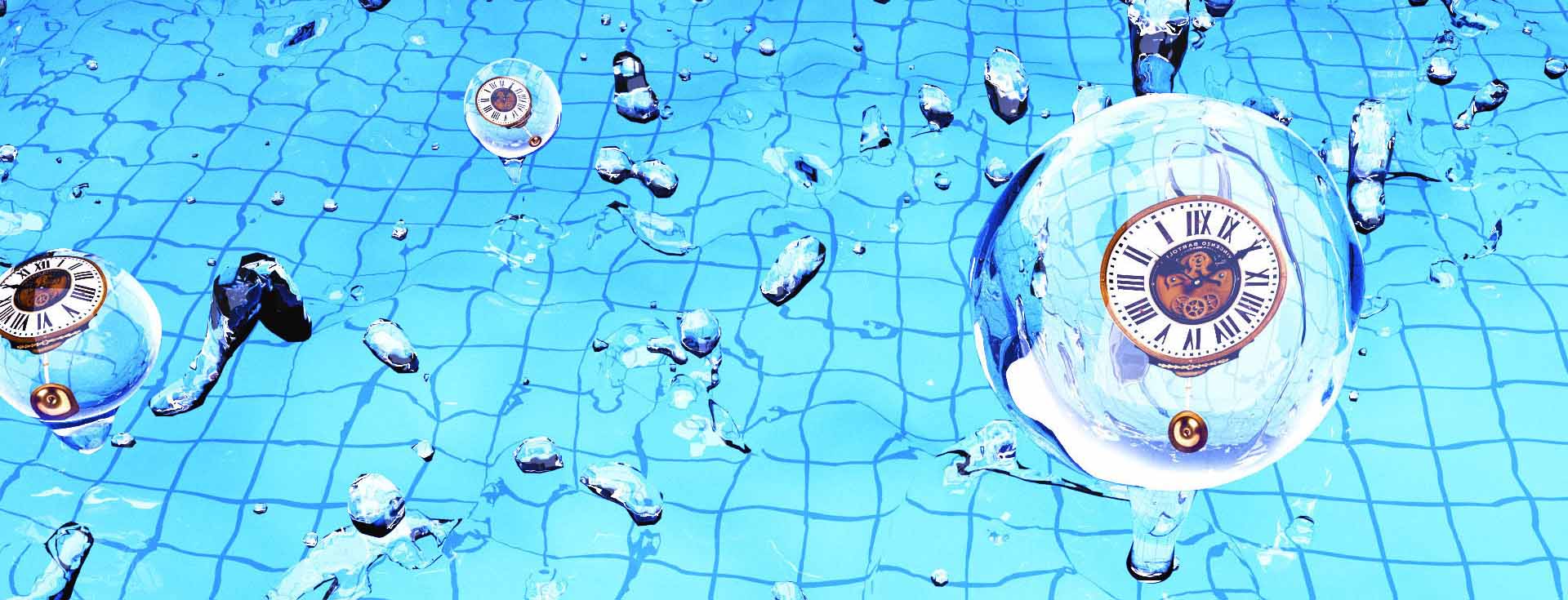
A massive particle is a quantum clock
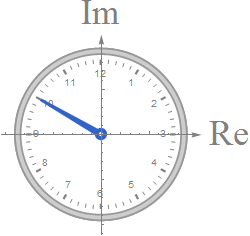
Xingang Chen, Mohammad Hossein Namjoo and I found a way to do it ( see also CW09a, CW09b, C11, AM15, CNW16). The idea is to make use of massive fields during inflation. The inflationary background excites massive particles out of those fields. We know that a massive field carries a phase, i.e. a complex number.
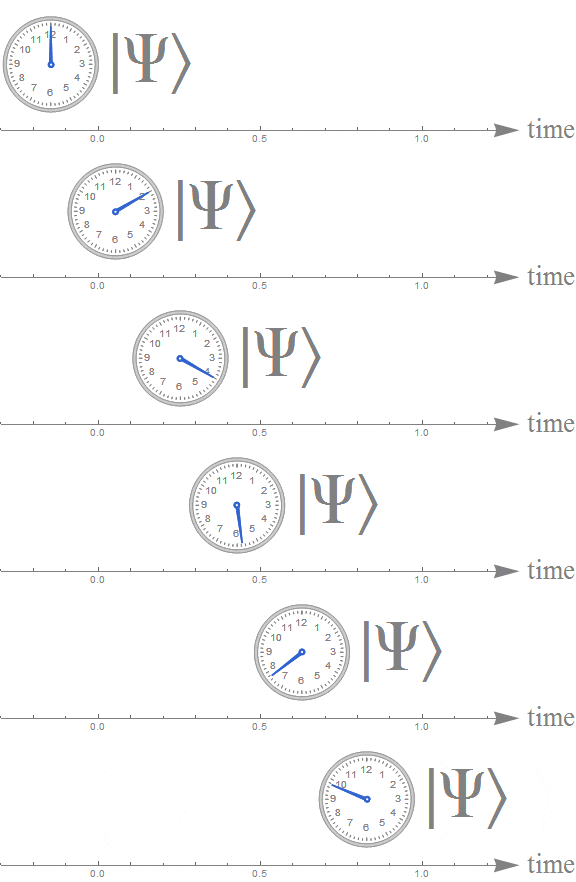
As time develops, the phase is time dependent. Thus it can be considered as a standard clock, recording the physical time of the primordial universe (click to replay the animation below).
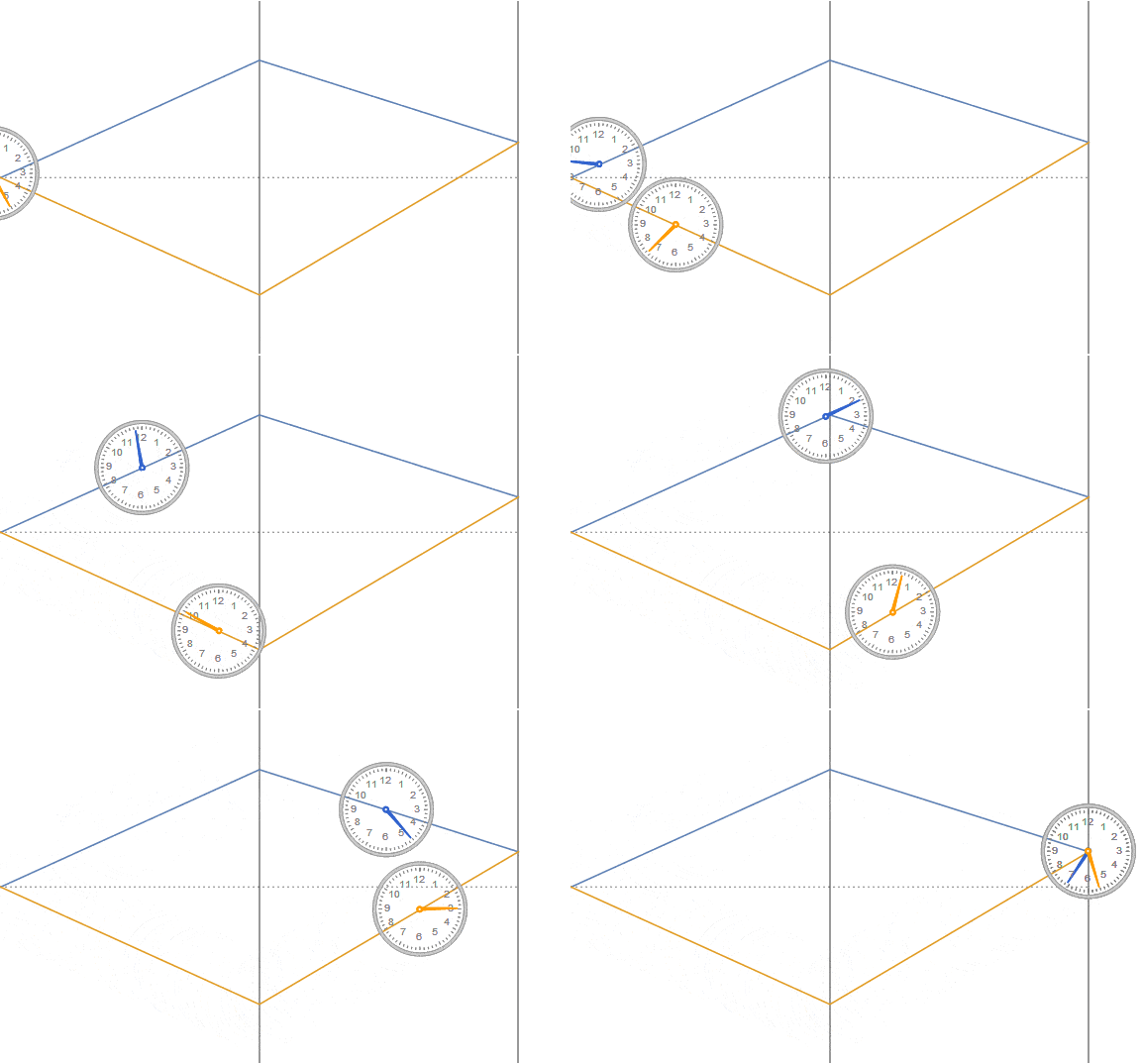
This phase is a fundamental feature of quantum mechanics, and is best illustrated and observed by the double slit experiment (click to replay the animation below).
The quantum phase in the classical sky
Once the signal from this primordial standard clock is recorded, we become to know how our universe develops during its very early stage.
And indeed, it is possible to see those clock signals, through 3-point or higher-point correlation functions in the sky, which are known as non-Gaussianities. The size of the non-Gaussianities depends on detailed model. But the shape is model independent and tells us about the expansion history of the primordial universe.
During inflation, or any other alternative scenarios in which the horizon problem is solved, the comoving horizon scale is shrinking. The fluctuations exit the horizon and become frozen until they re-enter the horizon at much later times. Fluctuations of different wavelength get frozen at different times.
Those fluctuation modes stack together (plus late time evolution) to form the observables, such as the CMB and the large scale structure.
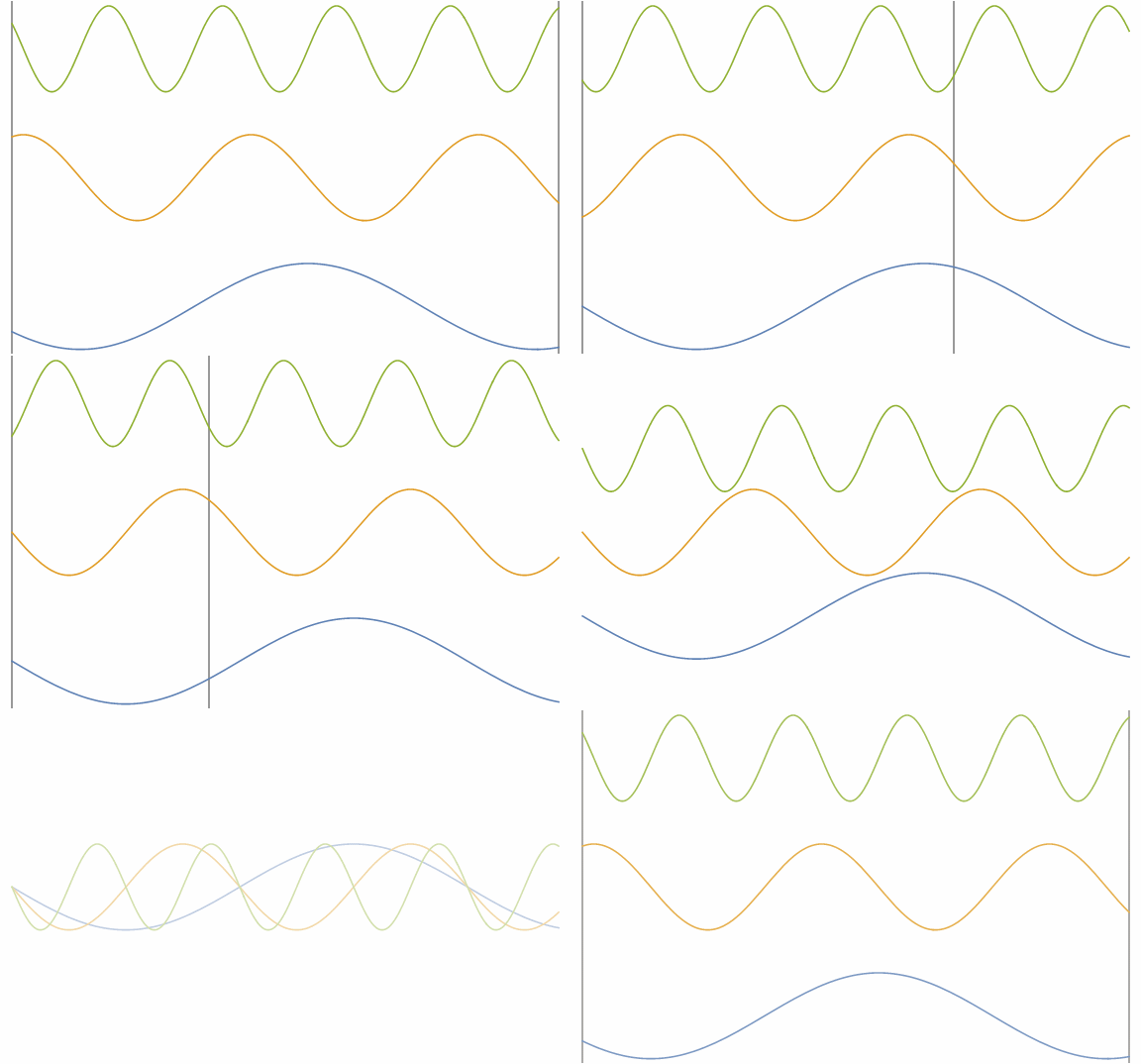
Now the key point: the massive particle has its phase, and the phase is recorded by the shorter wavelength density fluctuations through a resonance effect. Finally, the massive particle converts into density fluctuation itself as well. So the three-point function of density fluctuation obtains oscillatory features as a function of the squeezeness of the three point function (and the three-point function forms a triangle in momentum space thanks to momentum conservation).

Towards the experimental test
We look forward to the future moment that the observations of the clock signal on the CMB and the large scale structure can tell us the expansion history of the primordial universe.
The research also attracted some attention of the public. It was selected as the [cover story of HKUST] (http://www.ust.hk/cover-stories/unveiling-clock-universe-3/, and is reported by over 80 media/websites (e.g. [Daily Mail UK] (http://www.dailymail.co.uk/sciencetech/article-3416532/Does-secret-universe-s-origin-lie-quantum-wiggle-Primordial-clock-signals-reveal-Big-Bang-actually-CRUNCH.html.
Selected references
- Chen, Xingang; Namjoo, Mohammad Hossein; Wang, Yi. Quantum Primordial Standard Clocks (2015-09-13). arXiv:1509.03930. DOI · INSPIRE.
- Chen, Xingang; Namjoo, Mohammad Hossein; Wang, Yi. Probing the Primordial Universe using Massive Fields (2016-01-22). arXiv:1601.06228. DOI · INSPIRE.