手写讲义 · 第 2 页
2026-06-17 · 原始页面;PMB 位于本页下半部。
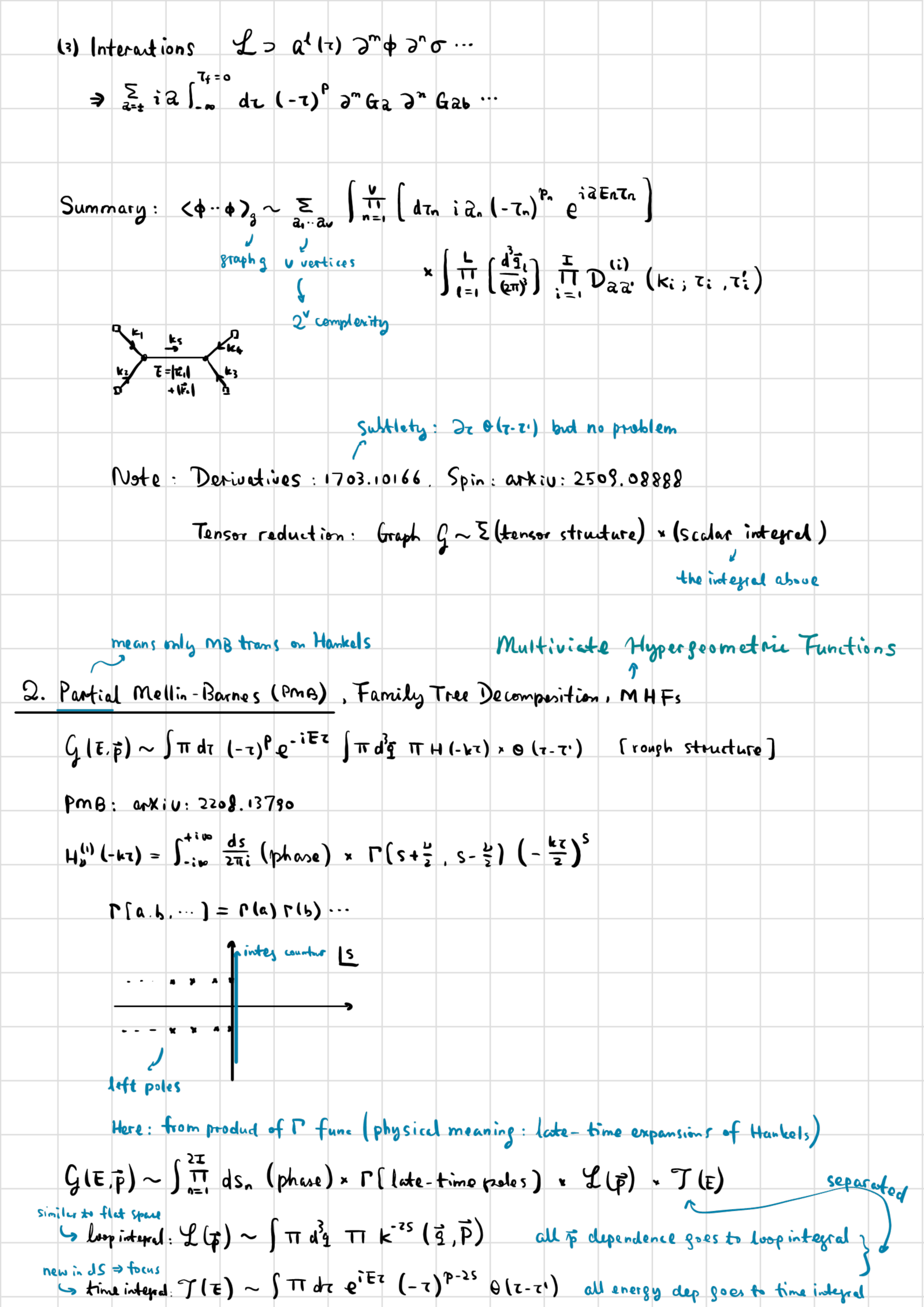
# Partial Mellin-Barnes Method

The partial Mellin-Barnes method is the bridge between raw Schwinger-Keldysh diagrammatics and closed analytic representations of cosmological correlators. The lecture introduces it after the basic diagrammatic rules, with [arXiv:2208.13790](../references/arxiv-2208.13790.md) as the named reference. It is also the computational engine behind [family-tree decomposition](family-tree-decomposition.md).

The lecture discussion separates two pieces of terminology that are easy to conflate. A "left pole" is any relevant pole lying to the left of the chosen Mellin contour. A "late-time pole" is more specific: it is a pole generated by the Hankel late-time expansion. Late-time poles are therefore a source-defined subset of contour-side pole data, not a synonym for every left pole. See [audio recording 1](../references/audio-recording-1.md), `00:41:17`-`00:41:32`.

## Source Anchors

- Lecture PDF page 2: PMB introduction, Hankel Mellin-Barnes representation, separation of loop and time integrals.
- Lecture PDF page 3: singularities, family-tree handoff, pole structure comments.
- [Audio recording 1](../references/audio-recording-1.md), `00:32:03`-`00:44:18`: PMB motivation, meromorphic Mellin integrand, partial-transform meaning, late-time versus left-pole distinction.
- [arXiv:2208.13790](../references/arxiv-2208.13790.md): PMB in helical inflation correlators.
- [arXiv:2309.10849](../references/arxiv-2309.10849.md): PMB as input to family-tree decomposition.
2026-06-17 · 原始页面;PMB 位于本页下半部。
Machine transcript: verify technical terms and formulas against the lecture or paper.

| Time Range | Topic | Improved Understanding | Wiki Action |
|---|---|---|---|
| `00:32:03`-`00:44:18` | Partial Mellin-Barnes setup | PMB addresses the Hankel-function obstacle by expanding selected Hankel functions into Mellin-Barnes power functions. The integrand becomes meromorphic in Mellin variables. "Partial" means the transform is applied to Hankel factors, not to the entire graph. Left poles are poles left of the contour; late-time poles are the subset generated by the Hankel late-time expansion. Loop/time factorization separates momentum dependence from energy/time dependence. | Use to clarify PMB terminology, pole taxonomy, and loop/time separation. |
| `00:41:17`-`00:43:25` | Convergence and pole caveats | The exchange of integrations/summations needs convergence or regulation. The speaker notes that loop divergences should be represented by regulator/cutoff dependence. The same MB representation can hold for arbitrary `\nu`, but pole families can merge or change. | Use as verification caveat in PMB module and recipes. |
### EB-002: Several handwritten arXiv ids unresolved

- Status: open
- Source: lecture PDF pages 3-6
- Issue: Some visible arXiv ids did not resolve through ARC/INSPIRE.
- Constraint: Treat unresolved ids as tentative handwritten readings, not verified papers.
- Verification: Recheck from audio transcript, speaker slides, arXiv search, or corrected handwriting.

### EB-003: Schematic formulas are not source-ready formulas

- Status: open
- Source: lecture PDF pages 1-6
- Issue: Many formulas are lecture schematics and may omit phases, contours, contact terms, or branch conventions.
- Constraint: For calculations, cite the relevant paper before using a formula as exact.
- Verification: Compare each recipe formula with the corresponding paper section.